
Understanding your bill is the first step to reducing your electricity costs.
We've created a handy guide to make it easy for you to read your bill.
Sample commerical bill
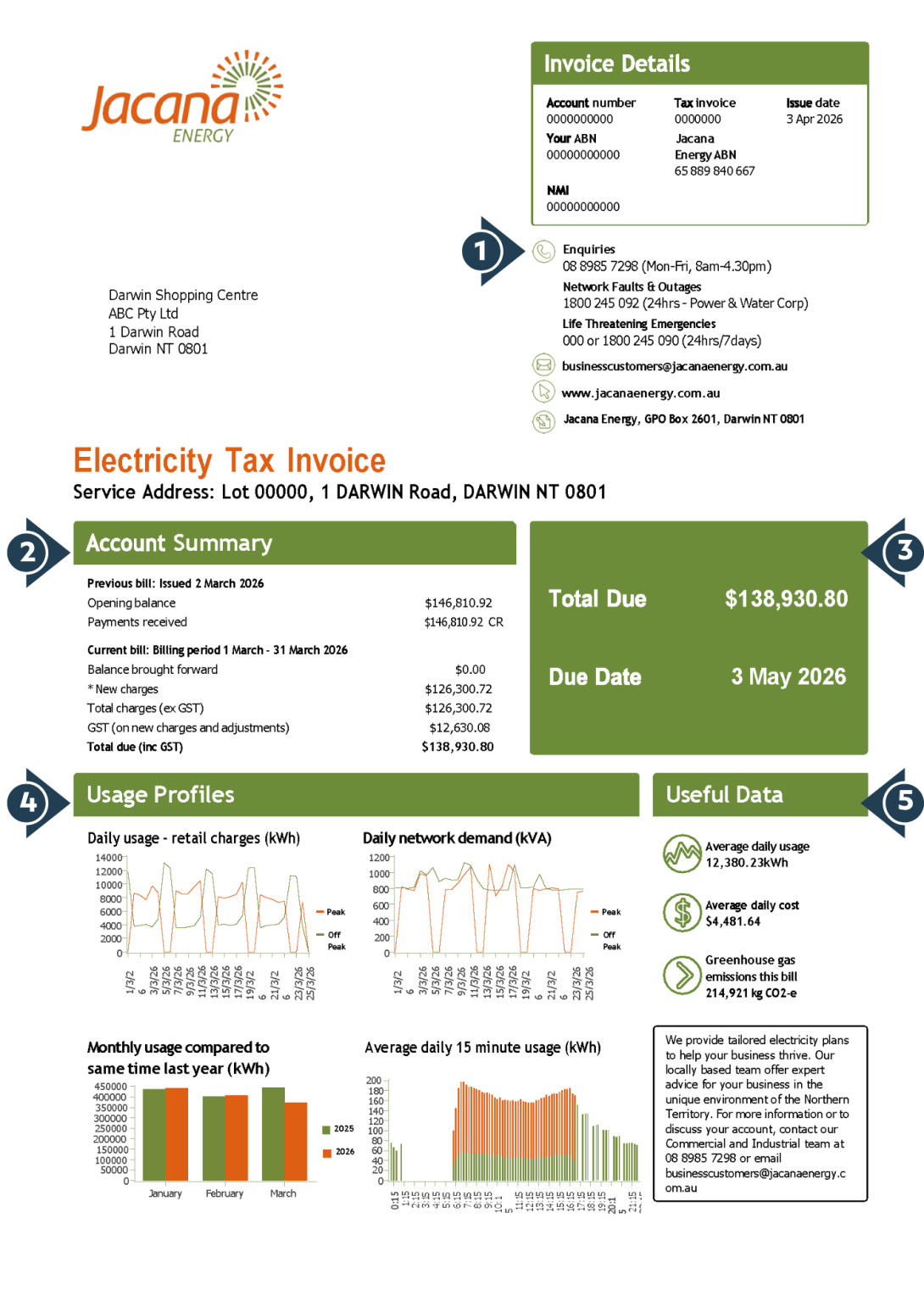
1 Useful contacts
2 Your account summary
Opening balance – Charges from your previous bill.
Payments received – All payments you have made since your last bill was issued.
Balance brought forward – Shows any amount owing from your last bill.
New charges – New charges for this bill.
Total charges – Includes both new charges for this bill and any previous amount owing from the last bill.
3 Payment amount and due date
4 Usage profile
Daily usage – retail charges (kWh) – Shows how much energy was consumed each day of the month, split into peak and off-peak periods.
Daily network demand (kVA) – Displays the demand recorded each day, by peak and off-peak times.
Monthly usage compared to same time last year (kWh) – Compares your current and previous months’ usage to the same time last year.
Average daily 15 minute usage (kWh) – Illustrates how your energy use varies throughout a typical day in 15-minute intervals.
5 Useful data
Greenhouse gas emissions – Amount of CO2 emitted by your premise during the billing period.
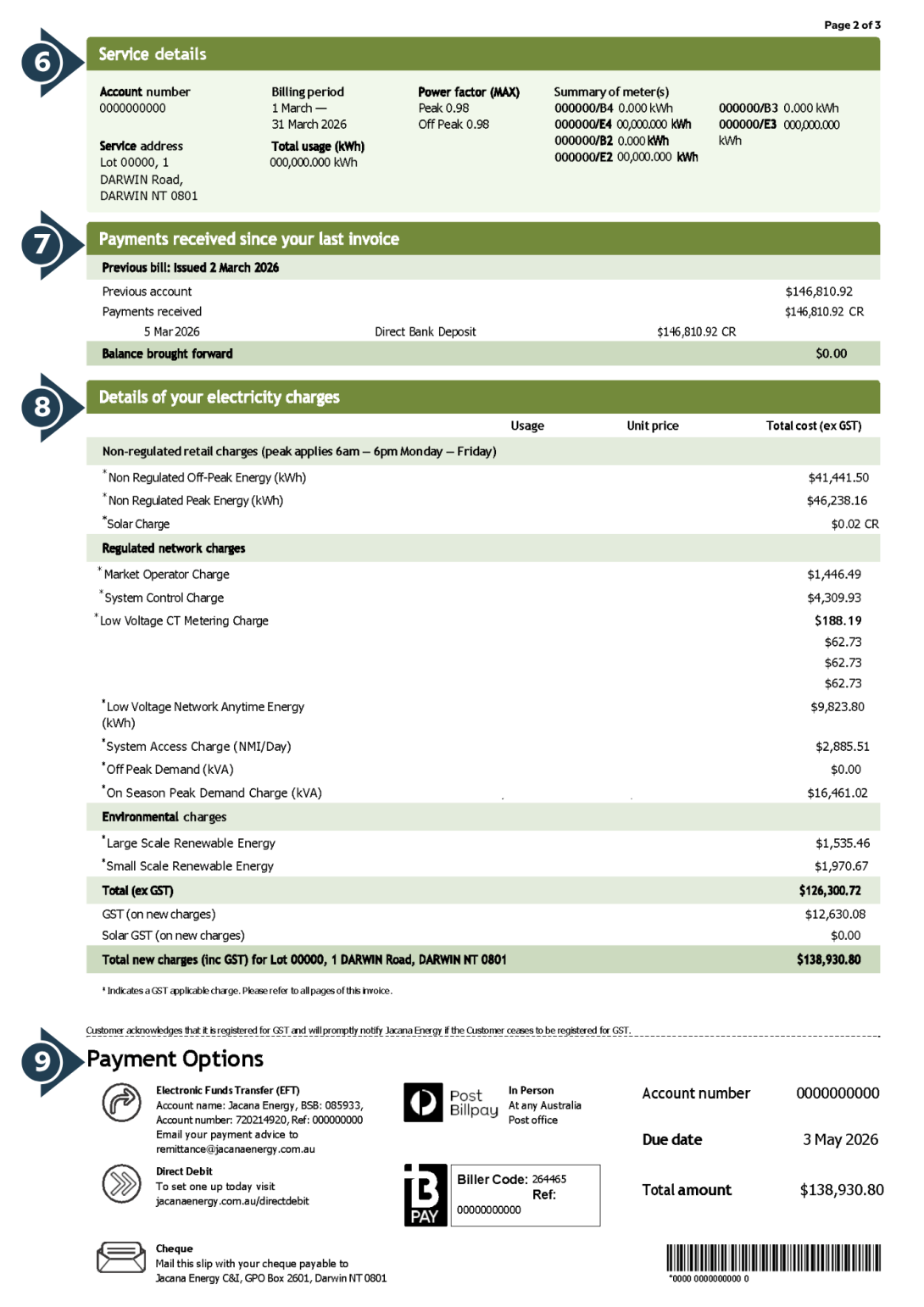
6 Service details
Account number – Your unique identifier for your Jacana Energy account.
Service address – The address of your property.
Power factor – The ratio of working power to apparent power. It is a measure of how efficiently your electrical equipment uses the power it draws from the grid.
Summary of meter(s) – Lists meters associated with your property and their serial numbers.
7 Payments received since your last invoice
Previous account – Charges from your previous bill.
Payments received – All payments you have made since your last bill was issued.
Balance brought forward – Shows any amount owing from your last bill.
8 Details of your electricity charges
Non-regulated retail charges – These charges are for the energy you use, charged according to your contract.
Regulated network charges – These prices are fixed by the NT Government and network provider. They cover the costs of building, maintaining, and operating the poles, wires, and substations that deliver electricity to your business.
Environmental charges – Outlines charges for large and small scale renewable energy certificates.
Total – The sum of all charges, discounts and adjustments.
9 Payment options
Different ways you can pay your bill and reference numbers to use when doing so.
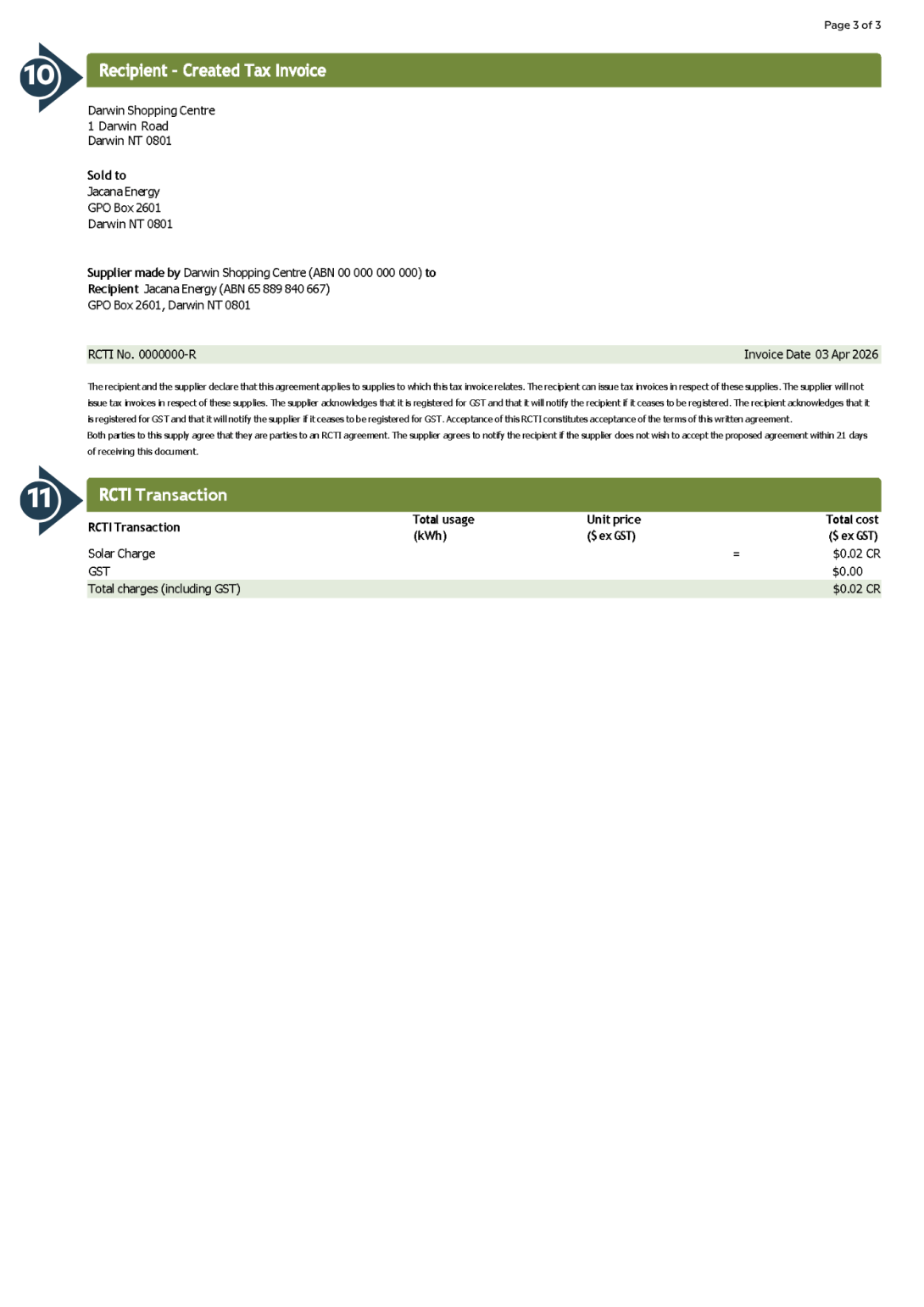
10 Recipient created tax invoice
Because your business is registered for GST, we generate this tax invoice on your behalf for the solar energy you sell back to us.
See more about recipient created tax invoices (RCTI) on the Australian Taxation Office website.
11 RCTI transaction
Details the transactions in the recipient created tax invoice.
- RCTI transaction – The pricing type that applies to the solar we are buying from you.
- Toal usage – The amount of excess solar in kilowatt-hours (kWh) you generated and sent back to the power grid, which was then bought by Jacana Energy.
- Unit price – The rate in dollars that applies per kilowatt-hour of solar energy.
- Total cost – The total amount of solar fed back into the grid multiplied by the unit price. This is the amount Jacana Energy pays to buy your excess solar for the billing period.